Built for Canadian carriers
Your safety file, read at highway speed.
Every abstract read the moment it lands, every expiry counted down, every driver scored, before the roadside, the insurer or the auditor finds what you missed.
Every abstract read the moment it lands, every expiry counted down, every driver scored, before the roadside, the insurer or the auditor finds what you missed.
Every abstract read the moment it lands, every expiry counted down, every driver scored, before the roadside, the insurer or the auditor finds what you missed.
One digest at six in the morning, about what is new. It never closes a record on its own.
Collisions are linked not only to skill but to judgement, stress, fatigue and impulse. Hiring screens experience and a driving record, and misses the rest, and the cost of missing it does not scale with the size of the mistake.
Illustrative, in Canadian dollars. These are not measurements of any carrier and not a promise of a result. They are the arithmetic of one avoided collision, shown so the rest of this page has a scale to be read against.
No migration project, and no month of data entry before it does anything useful.
A spreadsheet, a folder of PDFs, or nothing at all. Fifteen modules import from a file you export from this product and re-import unchanged; a blank cell never clears a value, and nothing is written until you have seen what would change.
Abstracts, CVORs, licences, permits, safeties and invoices are read on arrival and checked against their own validators.
Every renewal, inspection and interval on its own cycle, coloured on the rules a safety officer already applies by hand.
A score on every driver and a readiness figure for the carrier, both from records you already keep.
The work that keeps a safety file current is not hard. It is relentless, and it is the first thing to slip in a busy week. Marshall does it every day, and tells you what it did.
Abstracts, CVORs, licences, permits, safeties, emissions certificates, leases and invoices, on upload, without being asked. Marshall reads what arrives, an MTO abstract, a CVOR, a permit, a safety certificate, and fills the matching fields. Anything already entered stays exactly as it is.
Two vendors are kept behind Marshall, not one. They are scored against each other on real documents, the stronger one is used when the first answer fails its validator, and a monthly ceiling caps what the whole thing may spend.
Compliance fails on ordinary weeks, not dramatic ones. Marshall runs on a clock so a busy fortnight cannot quietly become a finding.
Every driver and every unit, against every rule. Alerts open the first time a date crosses a line, refresh while it stays crossed, and resolve themselves the moment the record is updated.
A single email to the people who asked for it, listing what is overdue and what is due soon, and only when something is new. A daily job that emails the same thing daily stops being read by Thursday.
A document is verified, classified, read and merged into the record it belongs to, into the blank fields only, the moment it lands.
Every licence, medical, annual safety and PM cycle is recomputed each night against the records on file, so an alert opens the day something comes due and closes itself the day it is dealt with.
Abandoned applications, half-finished imports and orphaned files are cleared on their own clock, and the record that an application was started is never what gets deleted.
Nothing automated writes a record a person has not confirmed, and nothing automated overwrites a value a person has entered. Those two rules are the reason the rest can be left running.
Both computed from records you already keep, and both show their working.
ModerateRecommended with monitoring
The two halves are averaged without weighting, so a poor record can be carried by strong behaviour. A driving record this low would be read as a hiring risk on its own, whatever the composite says, which is why the report shows the halves and not only the number.
The record half is the shipped HRD Crash Predictor, a 27-row weight table drawn from ATRI's crash-involvement research by way of the Northbridge and AIG high-risk-driver charts, inverted so the report counts safety upward. The behavioural half is the structured assessment's dimensions. Decision support, never a decision.
Every table carries the organisation, and every query and action is scoped to the one you are signed into.
Owns the account: the users, the settings and the organisation itself. The only role that can delete a record permanently, because destroying compliance history is an owner-level act.
Who, what, from what to what, and when, kept without limit and visible to every role including read-only.
Downloads, exports and sign-ins from a new device each write their own row.
Every table carries the organisation. An unscoped query does not compile.
SIN cards and direct deposit forms are stored and never sent to a model, enforced three ways.
Private storage behind short-lived signed links, passwords checked against known breaches, two-factor enforceable carrier-wide.
A failure gives one sentence and a reference. The detail goes to the log, not the screen.
Each one carries its own fields, its own natural key, its own status rule and its own import route. Nothing lives in a spreadsheet that the next person cannot find.
A link, not an account. The carrier's own paper package, step for step and in its own words, the documents before the questions they answer, every consent signed on its own, and a PDF package at the end with every answer, every signature and where each value came from.
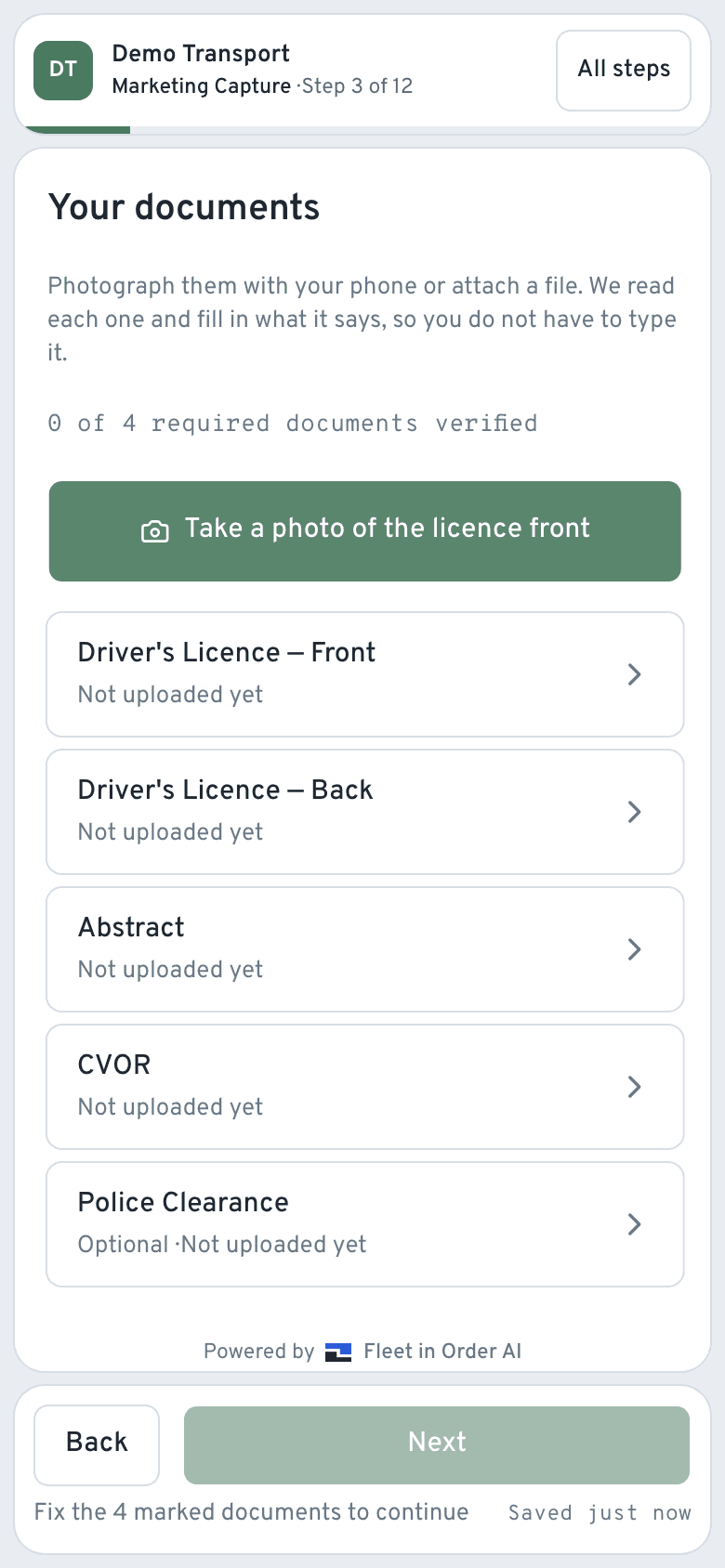
The carrier's logo, wordmark and accent colour sit on the page, not this product's; it is the carrier the driver is applying to. A licence read from the card locks the fields it proves, and the only thing the driver can do about a wrong value is say so, which staff see on review.
Safety spending is hard to justify because its return is an absence, the collision that did not happen. The point of a record this complete is that the absence is evidenced.
One price a month for the whole carrier, set by how many active trucks you run. Every plan has every module, every seat and the agent; trailers are not counted.
Canadian dollars a month, before tax, billed monthly, after a 30-day free trial that starts once your demo is done. The plan follows your count of active trucks as it changes. Enterprise is priced per contract.
Tell us about the fleet and we will walk you through it end to end, the countdowns, the agent reading a real abstract, the risk scores and the readiness gap list. Forty minutes, and no account is created until you ask for one.
© 2026 Fleet in Order AI. Built in Canada for Canadian carriers. Screenshots and example records come from a fictional demo organisation; no real driver appears on this site.